Nobody wants to read about policy. I understand. But the thing about getting suspended is that it does not happen gradually — you wake up one day and the shop is gone, and there is no phone number to ring.
Etsy updated its Seller Policy on 14 January 2026, and the Fees and Payments Policy on 13 February 2026. The seller-side changes matter a lot for print-on-demand specifically, because they sharpened the rules around production partner disclosure and creativity standards — the two areas where POD sits closest to the line.
So here is the plain version of what changed and what to actually do about it.
Print-on-demand is allowed. With conditions.
Let us start there, because people get anxious about this.
Etsy permits print-on-demand. It is not a loophole you are getting away with. But it is allowed *under specific conditions*, and the conditions are about transparency and authorship.
Two things Etsy wants to be true:
- You designed it. The creative work is yours.
- You said who made it. The manufacturing partner is declared.
If both of those are true and documented, you are fine. Most suspensions come from one of them being quietly false.
Production partners — declare them
This is the rule most commonly broken, and it is also the easiest to fix.
If someone else physically manufactures your item — Printify, Printful, Gelato, Gooten, a local printer, anyone — they are a production partner and Etsy requires you to declare them.
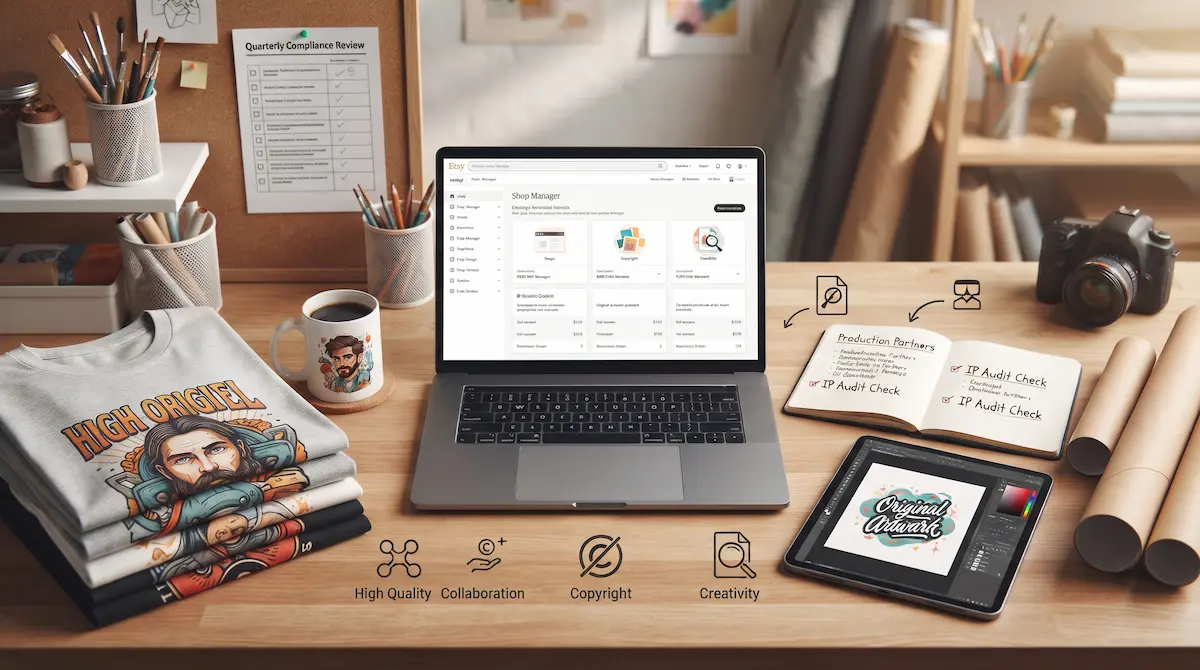
You do it in Shop Manager under Production Partners, and then you attach the relevant partner to each listing.
Two mistakes I see constantly:
Adding the partner but not linking it to listings. Creating the production partner entry is step one. You then have to attach it on each listing. A shop with a declared partner and 200 listings that reference nobody is still non-compliant.
Only declaring one when you use three. If you use different suppliers for shirts and mugs, both need declaring and each listing needs the right one.
It takes an afternoon to fix across a whole shop, and it removes the single most common reason POD shops get pulled. Go and do it.
Creativity standards — this is the vaguer one
Etsy's creativity standards say the seller must be meaningfully involved in the design of the item.
What that rules out:
- Uploading a supplier's stock catalogue design with no changes
- Bulk-generating thousands of listings by mechanically swapping a name into a template
- Reselling artwork you bought a commercial licence for, unchanged, as if you designed it
What it permits:
- Your own artwork, obviously
- Licensed elements that you have arranged, combined and typeset into something new
- Personalisation on top of a design you created
The grey area is bulk generation, and Etsy has been paying more attention to it. Three thousand listings that are the same design with a different first name swapped in is the pattern that draws scrutiny. Not because personalisation is banned — it is not, it is one of the best things you can do — but because a catalogue with no actual design variety looks like a script rather than a shop.
If most of your listings are mechanically generated variants, that is a real risk sitting in your business. It is worth knowing that even if you do not want to hear it.
Intellectual property — the one that ends shops fastest
Nothing gets a shop closed faster than repeat IP complaints. And POD sellers walk into this constantly because the designs that look most tempting are usually the ones lifted from somewhere.
The obvious stuff — Disney, Marvel, sports teams, band logos, university names — everyone knows. Where people actually get caught:
Song lyrics. Copyrighted. All of them. A line from a song on a shirt is infringement even if it is four words.
Quotes from films and TV. Same.
Fonts. A lot of free fonts are free for personal use only. Selling a product with one is a licence breach, and font foundries do enforce it.
Clip art and stock graphics. Check the licence covers commercial print-on-demand resale specifically. Many do not. "Free for commercial use" often excludes putting it on a product for sale.
Trademarked phrases. This is the sneaky one. Ordinary-sounding phrases get trademarked in specific product classes all the time. Before you put a phrase on a shirt, search it on the USPTO database. It is free and takes a minute.
Trends that are somebody's IP. A meme format, a catchphrase, a character from a viral video. Popular does not mean public domain.
Etsy operates on notice-and-takedown, which means the complaint is acted on first and you argue afterwards. Enough of them and the shop goes.
What else changed worth knowing
The transaction fee moved from 5% to 6.5%, and the February policy update clarified how fees, taxes and billing are applied. If you have not repriced since that went through, you are absorbing the difference yourself — worth checking your margins.
Offsite Ads remain mandatory above $10,000 in annual sales, at 12 to 15 percent on those orders. Not new, but it belongs on any list of things that quietly change the economics.
A twenty-minute compliance check
Once a quarter, honestly. Set a reminder.
- Production partners declared? Shop Manager, Production Partners. Are all your suppliers listed?
- Attached to every listing? Spot check ten random listings.
- Shop policies filled in? Returns, exchanges, processing times. Blank policies hurt your shop quality score as well as being a compliance gap.
- Any listing using a font or graphic whose licence you cannot find? Find the licence or pull the listing.
- Any phrase you have not trademark-checked? Check it.
- Anything that is a mechanical variant of something else, at scale? Think about whether that is where you want your risk.
The mindset that keeps you open
Etsy is not trying to catch you out. It is trying to stay a marketplace where buyers believe a person made the thing. Every rule here points at that.
If you design your own work, say who prints it, and do not use other people's IP, you are not going to have a problem. The shops that get shut down are almost never the ones that made an honest mistake — they are the ones that were running a script and hoping.
Build something you would be happy to explain out loud. That is basically the whole policy.
Short version: Declare your production partners and attach them to every listing. Make sure the design work is genuinely yours. Check font and clip-art licences cover commercial resale. Search phrases on the USPTO before printing them. Do a twenty-minute audit every quarter.