
Most print-on-demand sellers I talk to have a rough idea of their margin and it is usually wrong by about ten points. Not because they are bad at maths — because the fees are spread across four different places and one of them only appears on some orders.
So let us just sit down and do it properly on a real product. A $30 shirt with $5 shipping. Nothing exotic.
The fees, one at a time
Listing fee — $0.20
Twenty cents every time an item sells, plus twenty cents to list it in the first place, plus twenty cents every four months to renew. Small, but it is per item, and it adds up when you are running hundreds of listings that mostly do not sell.
For our shirt: $0.20
Transaction fee — 6.5%
This went up from 5% to 6.5%, which is a bigger deal than it sounds — that is a 30 percent increase in that particular fee.
And here is the bit that catches people: it applies to the order total including shipping. Not the item price. So our $30 shirt with $5 shipping is treated as a $35 transaction.
6.5% of $35 = $2.28
If you have been calculating 6.5% of $30 and getting $1.95, you have been under by 33 cents on every single order.
Payment processing — 3% + $0.25 (US)
Also on the full amount. 3% of $35 is $1.05, plus 25 cents.
$1.30
Worth knowing this varies by country. Germany is 4% + €0.30, the UK is 4% + £0.20. If you are selling internationally your blended rate is higher than the US number.
Your supplier
This is the big one and it is not an Etsy fee at all. A decent quality printed tee through a mainstream POD supplier, shipped, lands somewhere around $12 to $16 depending on the garment, the print size and how many colours.
Let us say $14 all in, including the shipping the supplier charges you.
So where are we
On a $30 shirt with $5 shipping — buyer pays $35:
- Buyer pays: $35.00
- Listing fee: −$0.20
- Transaction fee (6.5% of $35): −$2.28
- Payment processing (3% + $0.25): −$1.30
- Supplier cost including shipping: −$14.00
You keep: $17.22
Except you charged $5 shipping and it cost you money to ship, which is already inside that $14. Fine. So the honest number on a good order is around $17.22 profit on a $35 sale, which is roughly a 49 percent margin.
That is genuinely decent. That is the good version.
Now the version nobody plans for
Offsite Ads
Once your shop passes $10,000 in annual sales, Offsite Ads become mandatory. You cannot switch them off. When a sale comes through one of those ads, Etsy takes an additional 12 to 15 percent of the order total.
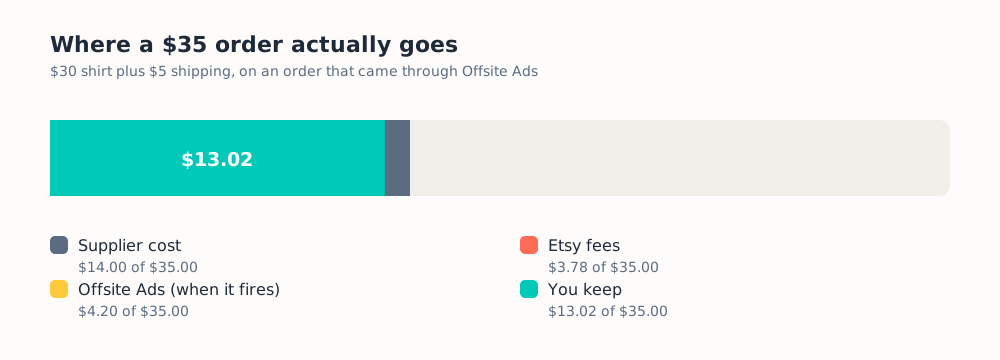
On our order, at 12%: another $4.20.
- You keep: $17.22 − $4.20 = $13.02
Margin drops from 49% to about 37%. On the same product, at the same price, with no warning, on an order you had no say in.
Combined fees on a normal order are roughly 11 to 15 percent. On an Offsite Ads order they are 23 to 27 percent. That gap is where a lot of shops quietly stop being profitable.
Etsy Ads, if you run them
Separate thing, and optional. But if you are spending $5 a day and getting three sales a day out of it, that is $1.67 off every order.
- You keep: $11.35
Now you are at 32 percent.
Returns, reships and mistakes
Somebody's shirt arrives with a crooked print. You reship it. That is a whole $14 gone, plus you have lost the profit on the original.
If that happens on 3 percent of orders — which is not a bad rate for POD — it is roughly another 4 percent off your blended margin.
Realistically, run the whole shop through and you are looking at somewhere around 28 to 35 percent net on a $30 shirt, not the 53 percent you get from just doing $30 minus $14 in your head.
What this actually tells you
Three things, and they all point the same direction.
1. $30 is too cheap for a shirt
At $30 the fees eat a fixed chunk and there is not enough left to absorb a reship. Push to $34 or $36 and almost all of that extra goes straight to you — the supplier cost does not move, and only the percentage fees scale.
$36 shirt, same $5 shipping, same $14 cost:
- Buyer pays $41
- Fees: $0.20 + $2.67 + $1.48 = $4.35
- Supplier: $14
- You keep: $22.65
You added $6 to the price and kept $5.43 of it. That is the highest-return change available to you and it takes thirty seconds.
The obvious worry is that fewer people buy. Sometimes true. But on Etsy, in gifting categories, price sensitivity is much lower than people assume — someone buying a personalised memorial gift for their mother is not comparing your $36 against someone else's $31.
2. Free shipping is usually worth it
Shipping over $6 domestic reduces your search visibility in 2026. So the choice is not really "charge shipping or absorb it" — it is "absorb it, or absorb a visibility penalty."
Build it into the price. $41 total as a $41 item with free shipping costs you the same in fees and ranks better.
3. High-cost, high-price products are better than cheap ones
Compare that shirt against a $60 personalised blanket that costs you $28.
- Buyer pays $60, free shipping
- Fees: $0.20 + $3.90 + $2.05 = $6.15
- Supplier: $28
- You keep: $25.85
Higher absolute profit per order, and you needed one sale instead of two. Same amount of customer service, same amount of listing work.
This is the argument for moving up-market rather than trying to win on volume. Fewer orders, same money, much less admin.
The thing to actually go and do
Open a spreadsheet. Put your five best-selling products in it. For each one, work out the real number including the 6.5% on the full order total and a realistic reship allowance.
I would bet money that at least one of them is making you almost nothing and you have never noticed, because it sells well and selling well feels like working.
Then either put the price up or stop making it.
And when you are picking the next product, factor this in from the start. A niche where people happily pay $45 for a personalised item is a fundamentally better business than one where $24 is the ceiling, even if the second one has ten times the search volume. That is worth knowing *before* you spend a weekend designing for it.
Short version: The 6.5% transaction fee applies to the order total including shipping, not the item price. Real net margin on a $30 shirt is around 28 to 35 percent once Offsite Ads and reships are in. Raise your prices, build shipping in, and lean towards higher-ticket personalised products.